




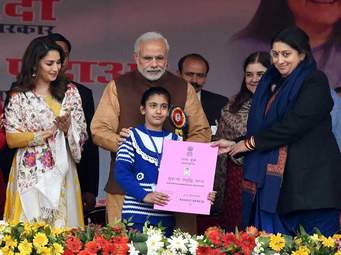
Beti Bachao, Beti Padhao ( Save girl child, educate girl child) is a Government of India scheme that aims to generate awareness and improve the efficiency of welfare services meant for women. The scheme was launched with an initial corpus of ?100 crore (US$15 million).[1] According to census data, the child sex ratio (0–6 years) in India was 927 girls per 1,000 boys in 2001, which dropped drastically to 918[2] girls for every 1,000 boys in 2011. A 2012 UNICEF report ranked India 41st among 195 countries. The Beti Bachao, Beti Padhao (BBBP) Scheme was introduced in October, 2014 to address the issue of declining child sex ratio (CSR). This is implemented through a national campaign and focused multi-sector action in 100 selected districts with low CSR, covering all States and UTs. It is a joint initiative of the Ministry of Women and Child Development, the Ministry of Health and Family Welfare and the Ministry of Human Resource Development. Speaking on the occasion of International Day of the Girl Child, Prime Minister Modi, called for the eradication of female foeticide and invited suggestions from the citizens of India on "Beti Bachao, Beti Padhao" on the MyGov.in portal.[3]
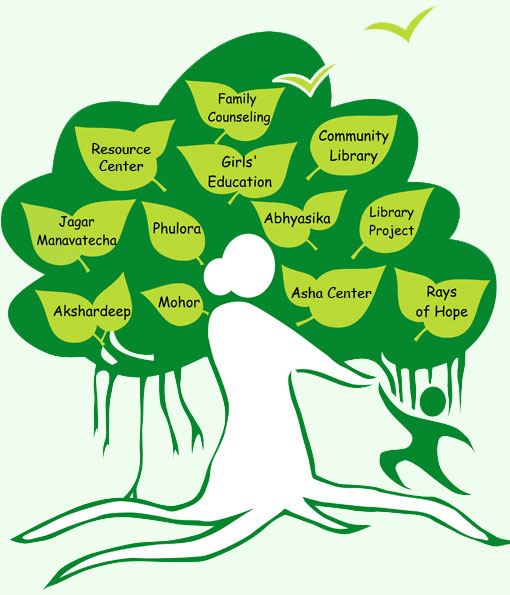
"Swadhar, IDWC Pune" a registered Non-Governmental Organization (NGO), was established in July 1995 as a branch of Swadhar, Mumbai; after completing 12 years of working with women in Mumbai. Swadhar IDWC came into existence to help women in distress, irrespective of their caste, creed or religion. "Swa-adhar" means self-reliance. Our aim is to support women to become independent in spirit, in thought, in action and have full control over their lives rather than be the victim of others? actions. Work with women in distress cannot be in isolation and almost always includes work with children. Swadhar, IDWC therefore decided to work with children too. It works mainly with under-privileged people from the low income groups in the Bibwewadi and the PCMC areas of Pune city. Membership of Swadhar, IDWC is open to all, both men and women. Registration No. Maharashtra/1724/2002/Pune E-mail address: contact@swadharpune.org
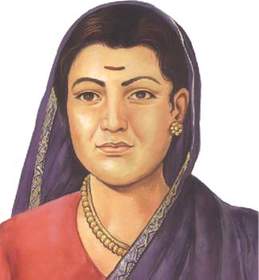
Savitribai Jotiba Phule (January 3, 1831- March 10, 1897) was a social reformer who along with her husband, Mahatma Jotiba Phule played an important role in improving women's rights in India during the British Rule. Savitribai was the first female teacher of the first women's school in India and also considered as the pioneer of modern Marathi poetry. In 1852 she opened a school for Untouchable girls. Mahatma Jyotiba is regarded as one of the most important figures in social reform movement in Maharashtra and India. He is most known for his efforts to educate women and the lower castes. Jyotirao, then called as Jyotiba was Savitribai’s mentor and supporter. Under his influence Savitribai had taken women’s education and their liberation from the cultural patterns of the male-dominated society as mission of her life. She worked towards tackling some of the then major social problems including women’s liberation, widow remarriages and removal of untouchability. However, apart from all these oppositions, Savitribai yet continued to teach the girls. Whenever Savitribai went out of her house, groups of orthodox men would follow her and abuse her in obscene language. They would throw rotten eggs, cow dung, tomatoes and stones at her. She would walk meekly and arrive at her school. Fed up with the treatment meted out to her, she even decided to give up. But it was because of her husband that she continued with her efforts. He told Savitribai Jyotiba who was working for women's education had started the first girl’s school and required women teachers to assist him. Jyotiba educated and trained Savitribai, his first and ideal candidate for this job of a teacher. Savitribai and Jyotiba faced fierce resistance from the orthodox elements of society for this. Jyotiba sent her to a training school from where she passed out with flying colours along with a Muslim lady Fatima Sheikh.